
Euclid release highlights UK space science and computing capability
Galaxy catalogue links telescope engineering with large-scale data analysis
Euclid’s DR1-Foundation data release captures some 900 million galaxies from one year of observations, according to a Newcastle University announcement. Software developed by Newcastle astronomer Dr James Nightingale is helping researchers analyse thousands of gravitational lenses, where massive objects bend light from background galaxies.
The release totals 1.7 million gigabytes. UK contributions include leadership of the visible instrument’s design and build, plus analysis pipelines developed by seven universities. The UK Space Agency has invested £54 million in the mission, not the total project cost. First cosmology results are expected in 2027.
Why this matters for policymakers
- Computing capacity Our analysis: assess whether research computing provision can support mission-scale datasets.
- Funding accountability Our analysis: track scientific outputs alongside instrumentation and software investment.
- Skills Our analysis: consider sustained support for detector engineering and astronomical data analysis.
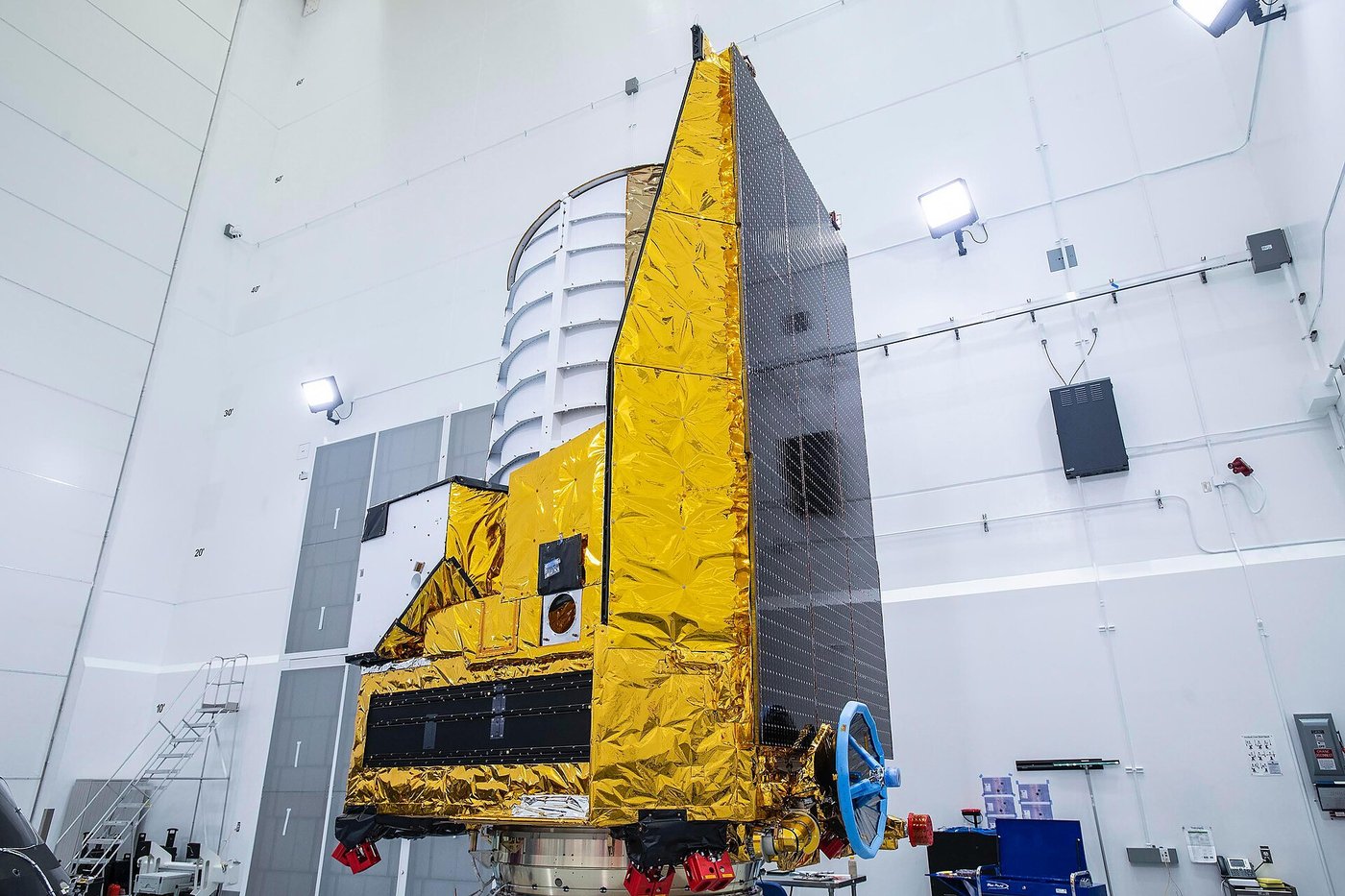
Image: The Euclid spacecraft being secured to its launch adaptor before launch, rather than imagery from the data release. Photograph: NASA Jet Propulsion Laboratory. NASA Jet Propulsion Laboratory, Public domain. Resized and converted to JPEG for display.